%20(1500%20x%20600%20px).png)
Rooftop Solar for the Dawn: What I'm Thinking About Adding and Why

There's a moment every boondocker hits where you look at your setup and think: this works. But could it do better?
Before I got the BLUETTI Elite 300, I was running an AC200L paired with a B300K expansion battery. That combo was a powerhouse in every sense of the word. Together they tipped the scales at over 127 pounds. Getting them in and out of the car was a serious workout, and neither one ever saw the inside of the camper.
The Elite 300 was a real upgrade. Lighter, more capable, and genuinely a great unit. But it has a quirk that became a real limitation in the field: it only accepts solar input in parallel, not series, which means you hit a current ceiling well before you reach its 1,200 watt maximum. In practice, getting meaningful solar harvest into it is harder than the spec sheet suggests. Add in the job of recharging the Dawn's house batteries on top of my regular power needs, and on cloudy days or heavy use days, the system was stretched thin.

That's the problem I'm solving. And honestly? Solving it feels on-brand for where I am right now. This whole chapter of my life, the Sol Wanderer, the camper, the reinvention, has been about figuring out what actually works for me and then building something better. The power system is no different.
Rooftop solar wired directly to the house batteries would take that double-duty job off the Elite 300's plate, and let the whole system breathe.
Here's what I'm figuring out. And what I could use some help with.
The Dawn and Solar: A Quick Note for Fellow Owners
If you own an inTech Sol Dawn, you may have seen the factory solar upgrade options: a 200 watt panel and 30-amp charge controller, or a full off-grid package with 300 watts of solar, lithium batteries, and a 2,000w inverter. They exist. They're great options at purchase.
Mine didn't come with any of them.
That's not a complaint. It's just context. I bought my Dawn and built my power system as I went, learning what I actually needed along the way. One upgrade I did make early on: swapping out the stock AGM battery for two Renogy 100ah lithium batteries. Better capacity, better performance, and a much better fit for the way I camp.
Here's something worth knowing for fellow Dawn owners: the trailer does come standard with a pre-wired solar port on the side wall. Sounds promising, right? It is. But it's a Zamp port, and that comes with a catch. Zamp ports use polarity-protected SAE plugs, which means they are only compatible with Zamp Solar products. You can't just grab any solar panel, plug it in, and call it a day. You're either buying into the Zamp ecosystem for portable charging, or you're looking at a more involved installation to use other components. It's not exactly the plug-and-play situation the phrase "solar ready" might lead you to expect.
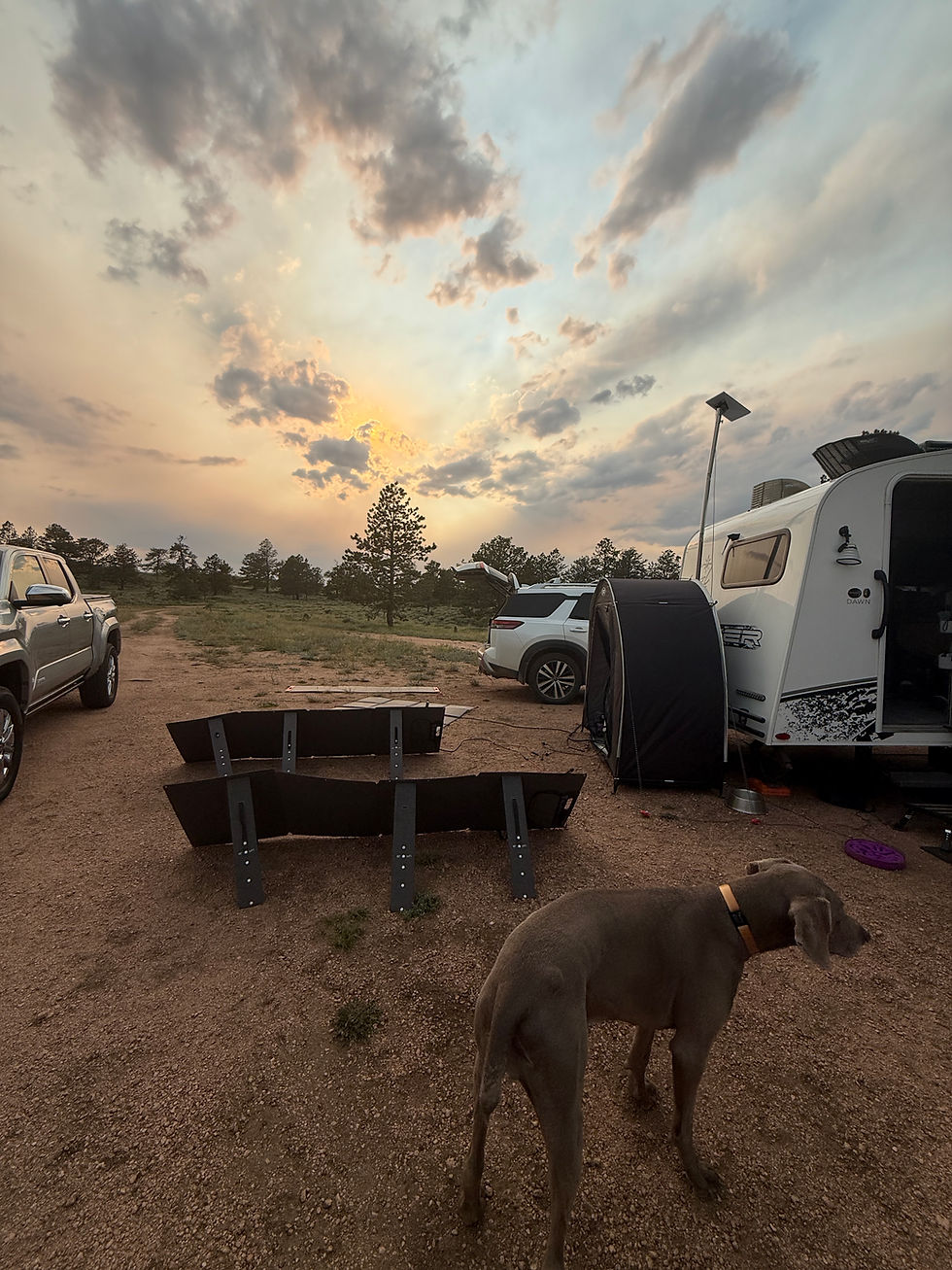
Which is part of why a rooftop install with a dealer is on my radar. If I'm going to do this, I want it done right and I want it to work with the rest of my system. Not around it. But I'm still in the research phase, and I have a lot of questions.
If you're in the same boat, a Dawn owner with no factory solar and a lot of questions about what it would take to add it, this post is for you. And if you're still shopping for a Dawn and deciding whether to add solar at purchase, stick around. This might help you think it through too.
My Current Power Setup
Let me paint you a picture of what I'm actually running out here. It's not simple, but it works. And it has evolved as my needs have changed.
The heart of the system is the BLUETTI Elite 300. It handles the Dawn's house batteries and powers my daytime needs. It's a genuinely impressive unit: 3kWh packed into a surprisingly compact design, and a big step up from what I was running before.
My first Elite 100 runs Starlink. All day, every day. And yes, it also powers the TV at night. I'm not apologizing for that. I recently added a second Elite 100. It doesn't have a dedicated job yet, but it will get worked into the rotation as the system evolves. My little Elite 30 V2 (I call her Pinky) handles phone and iPad charging overnight.
Rounding out the setup: a Jackery 1000 paired with its own dedicated 200w solar panel runs my ICECO fridge. That one lives in its own little ecosystem and doesn't pull from anything else.
For solar input, I have a 400w Renogy solar blanket or a set of four 200-watt BLUETTI panels in series-parallel feeding the Elite 300. On a good sunny day, the system hums. On a cloudy day, or after a stretch of heavy use, things get tighter than I'd like.
I'll be honest about something else too. I've known from the start that this setup isn't the most efficient way to move power around. Running everything through portable power stations means converting from DC to AC and back again, and every conversion costs you something. That power loss is real and I've always known it was a trade-off. But when I bought the Dawn, a full integrated solar system wasn't in the budget. This setup was the best solution I could build for the money I had at the time. It got me out there, it kept me running, and it taught me a lot about what I actually need. That's not nothing.
Here's what I've come to suspect: the biggest drain on the Elite 300 isn't Starlink or the laptop or the photo editing. It's the house batteries. Every time those two Renogy 100ah lithium batteries need a recharge, the Elite 300 is the one doing the work. That's the double-duty problem I'm trying to solve.

The Hypothesis
Here's my theory, and I'm putting it out there because I genuinely want to know if I'm thinking about this right.
The Dawn's house batteries are the hidden power drain on my Elite 300. Every time those two Renogy 100ah lithium batteries need a recharge, the Elite 300 is the one doing the work. Add in my regular daytime power needs: laptop, photo editing, Starlink backup. On anything less than a perfect sunny day, the system is working harder than it should have to.
My hypothesis is this: if I add rooftop solar wired directly to the house batteries, with a dedicated MPPT charge controller managing that relationship, the house batteries take care of themselves. The sun feeds them directly. The Elite 300 gets relieved of that job entirely and can focus on what it's actually good at.
In theory, that changes everything about how the system feels on a cloudy day or a high-use day.
Here's the thing nobody warns you about when you start researching solar upgrades: the rabbit hole has a rabbit hole.
I spent an embarrassing amount of time staring at wiring diagrams trying to understand why the Elite 300 hits its solar ceiling so fast. The answer comes down to series versus parallel configuration. Without getting too deep into the weeds: panels wired in series stack voltage, panels wired in parallel stack current. The Elite 300 has voltage limits lower than my trusty AC200L had, which means my 800 watts of panels would have to be wired in a series-parallel configuration just to stay within those limits. That's not impossible. It's just a lot. I was at camp, the Elite 300 wasn't charging, and I could not figure out why. One meltdown later, I ended up dragging out my hefty old friend the AC200L to save the day. And somewhere in the middle of that very humbling afternoon, I found myself staring at dongle options and wiring diagrams thinking: there has got to be an easier way than this.
As it happens, there was one small win buried in that research spiral. My gear list has always included a grab bag of extra cables and connectors, the random stuff I threw in thinking I'd probably never need it. Turns out I needed it. Having the right cable on hand when you're deep in a configuration experiment at a campsite is the kind of thing you don't appreciate until the moment you desperately do. If you don't already keep a running list of what's in your kit, that's exactly what the Wanderlist is for. It's where I track mine, and it's free. [thesolwanderlist.com]
There's one thing that's been nagging at me though. One of the things I love about my current setup is flexibility. I can park in the shade, let the dogs cool down, and not worry about whether the sun is hitting my panels. If I move to rooftop solar as the primary source for the house batteries, I'm suddenly dependent on being parked in full sun.
I suspect the Elite 300 becomes the backup for exactly this scenario: cloudy stretch, heavy tree cover, full shade campsite. And the rooftop system handles the sunny days. But I'm not sure how that handoff works in practice, or whether 400 watts of rooftop solar gives me enough margin that a partly shaded day isn't a crisis.
And here's another one I keep turning over: that Zamp port on the side wall: can I use it to plug in additional portable panels as a supplement to rooftop solar? Could it become my shade-camping backup input? Is there a way to use non-Zamp panels with it, or am I stuck in the Zamp ecosystem? And if I do have a rooftop MPPT system installed, do the two play nicely together or are they completely separate?
Dawn owners: I need you on this one.
But here's where I want to hear from you more broadly. Is my thinking correct? Is the house battery recharge cycle really the biggest draw on a system like mine? Have you done this upgrade on your Dawn or another small trailer? Did it make the difference you were hoping for? And a practical one I haven't been able to nail down yet: how many watts of panels can you actually fit on the roof of a Dawn? I want at least 400w, but is that realistic given the roof space, the vents, and everything else up there?
I have a lot of questions and not a lot of answers yet. That's kind of the point of this post.
What a Rooftop System Actually Needs
If you're new to this like I am, the component list can feel overwhelming fast. So here's how I'm breaking it down after my research. A rooftop solar system for the Dawn has three main pieces.
The panels. This is the part most people think of first. For my situation, I'm looking at a minimum of 400 watts of rooftop solar, though how much I can actually fit on the Dawn's roof is one of the questions I'm still trying to answer. Rigid monocrystalline panels are the standard for a permanent rooftop install. They're more efficient and more durable than flexible panels, and they're what most dealers will work with.
The MPPT charge controller. This is the brain of the system. It sits between the panels and the batteries, regulating the charge so your batteries get exactly what they need without being damaged. MPPT controllers are significantly more efficient than the cheaper PWM alternative, and for lithium batteries specifically, they're the right choice. The Victron SmartSolar is the name that comes up over and over in the inTech community and in the broader RV solar world. It has Bluetooth monitoring through an app, which means you can actually see what your system is doing in real time. That matters to me.
Wiring, fuses, and mounting hardware. The unglamorous part. This is also where a bad DIY job can cause real damage: to your roof, your batteries, or both. More on that in a minute.
Based on my research, a professionally installed 400w rooftop system with a quality MPPT charge controller is likely to run somewhere in the $1,000 to $1,800 range for parts and labor. That number will vary based on your dealer, your components, and how complex the install turns out to be. Get a quote. Get more than one if you can.
One question I'm sitting with: is 400w the right number, or should I be sizing up from the start? The factory off-grid package tops out at 300 watts, which makes me wonder how much roof space we're actually working with on the Dawn. Could you fit 400 watts up there? 600 watts? Is the roof profile and the AC unit the limiting factor? If you've done this install, I want to know what wattage you landed on, what fit, and whether you wish you'd gone bigger.
The Battery Question
While I'm thinking about rooftop solar, I'm also thinking about what's underneath it: the house batteries themselves.
Right now I'm running two Renogy 100ah lithium batteries, which gives me 200ah of capacity. That has worked. But if I'm adding rooftop solar specifically to keep those batteries fed, it raises a question worth asking before I pull the trigger on anything: is 200ah the right number, or should I be upping my capacity at the same time?
I've been thinking about going to 400ah or more. The logic makes sense to me. If the whole point of this upgrade is to give the house batteries their own dedicated power source, why not give them more capacity to work with while I'm at it? Doing it all at once, as part of a dealer install, seems smarter than coming back later and redoing the work.
But then I look at my actual usage. The furnace is propane, so no significant draw there. Overnight, I'm running the fridge, the Maxxair fan, and the lights. That's pulling through roughly a quarter of my battery capacity by morning. Which means I'm waking up with about 150ah still in the bank. That's actually pretty comfortable.
So maybe 200ah is enough. Maybe the real win here isn't more battery capacity. It's just making sure those batteries get reliably topped off every day without leaning on the Elite 300 to do it.
I genuinely don't know. And that's the question I'm putting to you. If you have a Sol Dawn, what are you running for house battery capacity? Did you upgrade from the stock setup? What do you wish you had known before you sized your battery bank? Is 200ah plenty, or is there a reason to go bigger that I'm not seeing yet?
I'm all ears.

Why I Will Be Handing This One Off to the Professionals
If you spend any time in the inTech Sol owner groups on Facebook, you have seen what people are doing with their rigs. Custom solar installs, battery upgrades, full electrical overhauls, done cleanly, done correctly, documented with photos and shared generously with the community. It is genuinely impressive. That community is one of the best things about owning an inTech Sol.
I am not those people.
And I mean that with zero shame. I know what I'm good at. Climbing on my roof with a drill and running wiring through my camper walls is not on that list. I have watched enough "it seemed fine until it wasn't" stories play out in those groups to know that a bad solar install isn't just an inconvenience. It's a roof leak, or a wiring fire, or a dead battery bank. The things that go wrong when this isn't done right are expensive and sometimes dangerous.
So I'm handing this one off to the professionals. A professional install means the roof penetrations are sealed correctly. It means the wiring is sized right for the load. It means someone who does this for a living has looked at my specific rig and made sure everything works together. That peace of mind is worth the labor cost to me.
It also means that if something goes wrong, I know exactly who to call.
If you've had a dealer install rooftop solar on your Dawn or another small trailer, I want to hear about your experience. Who did you use? What did it cost? What would you do differently?

Ask All the Questions
This isn't about fixing a mistake. My system has worked. I've learned more about power management in the last couple of years than I ever expected to, and that knowledge came from actually living with the setup I built, the good days and the tight ones. I don't regret a bit of it.
But needs change. That's the thing nobody tells you when you're starting out. You think you're building a system and then you're done. What actually happens is you learn your usage, you learn your rig, and you start to see what would make life out here easier and simpler.
It took a torrential downpour on my last trip to really drive that home. My BLUETTI was set up under the camper like always, and when the rain hit hard and fast, she got splashed. I cannot adequately describe the panic of watching that happen in real time. She survived. Tough little unit. But I stood there in the rain thinking: I cannot do this again. I will not do this again.
For me, right now, the answer is rooftop solar feeding the house batteries directly, less gear living under a tarp, and my BLUETTIs tucked under the bed where they belong. Less schlepping. More time just being out there.
I don't have this figured out yet. I'm in the research phase, asking questions, and hoping the people who have already done this will share what they know. If you've added rooftop solar to your Dawn or another small trailer, I want to hear everything: what you installed, what it cost, what you'd do differently, and whether it made the difference you were hoping for.
Drop it in the comments. I'll be reading every one.
Keep Moving.
Rachel


Comments