%20(1500%20x%20600%20px).png)
What Works, What Doesn’t, and What I Ordered by Day Three

Packing Your Small Camper for the Long Haul
Affiliate Disclosure: This post may contain affiliate links. If you purchase through one of my links, I may earn a small commission at no extra cost to you. I only recommend products I have personally used and genuinely stand behind. Your support helps keep Sol Wanderer on the road. Thank you.

There is a specific kind of panic that sets in when you are standing in your driveway at 6 a.m., your Pathfinder packed absolutely to the gills, 1,800 miles between you and the camper of your dreams. And you realize you forgot the dog kennel.
I won’t pretend I had it together. I was equal parts terrified and electrified, jamming things into the car with the energy of someone who had done a lot of research and absolutely no practice runs. Somewhere between the excitement and the overwhelm, the kennel didn’t make it. I was headed to Buffalo to pick up Curiosity, my inTech Sol Dawn, and hoping I hadn’t forgotten anything else I’d need. As if there were no Walmarts in Buffalo.
(There are many Walmarts in Buffalo, for the record.)
I had spent weeks reading packing lists from full-time RVers, van lifers, and weekend campers. None of them were quite right for me. They were either overwhelming or built for someone with a 40-foot rig and a gear budget I didn’t have.
I turned to YouTube next and found that videos from teardrop trailer owners were far more helpful. Closer to my scale, closer to my situation. But even then, not quite right. Curiosity has her own personality, her own storage quirks, her own way of asking you to live in her. I couldn’t find a resource that was built for someone like me - not a full time road warrior, but someone who would be living in her RV as full time as she could.
So you know what they say: if you can’t find your tribe, create it. That’s part of why this space exists!
So I’ll tell you what I’ve actually learned. Not what the internet said. What I discovered through trial, error, and a lot of “why did I buy that?” moments. Some things I bought turned out to be too cumbersome and never quite earned their space. And some things I use every single day that I’d recommend to anyone without hesitation.
This is that list.
This list has changed a lot since that first drive to Buffalo. What I packed then was what I thought I needed. What I pack now is what I know I need, along with a few things that have absolutely no practical justification and make me happy every single day.
Fair warning: it’s a long one. I wanted to give you everything in one place rather than leave anything out, so bookmark this one for future reference. You’ll want to come back to it. I’ll be breaking down the gear I love in more detail as I go, with honest reviews and the occasional affiliate link for the things I genuinely reach for every day. There’s a lot more to come.

Before We Talk About What to Pack
First, a reframe: the goal isn’t perfection. It’s your best guess of what will work.
I bought things I was certain I’d use constantly and they turned out to be too cumbersome, too awkward, or just not how I actually live on the road. And I found things I reach for every single day that I’d put on every new camper’s list without question. You won’t know which is which until you’re living it. That’s not failure. That’s the process.
Second: You do not need to have everything figured out before you leave. You need enough to be safe, comfortable, and able to sleep. Everything else is a future version of you’s problem, and future you will have opinions.
One of the most important questions to ask yourself before you start packing is this: how are you planning to camp?
Will you be boondocking 100% of the time, relying entirely on your own power and water? Staying at full-hookup campgrounds where shore power and water connections are always available? Or somewhere in the mix of both?
This matters more than almost anything else on your list. Your power setup, your water storage, your cooking system should all match your mission. A gear list built for full hookups will leave you scrambling off-grid, and vice versa. Know your style first. Then pack for it.
What’s sufficient for a weekend might drive you absolutely nuts after three weeks. Pack for how you actually plan to live, not how you imagine you might.
The Must-Haves (At Least According to Me)
These are non-negotiables. If you forget any of these, your night will be harder than it needs to be.
Sleep

Bedding you’ve tested at home. Don’t save the “camping bedding” reveal for the first night. Know you can sleep in it.
A mattress topper, at minimum. Start here on night one. I did. But by the end of my first week on the road, I had already ordered a five-inch replacement mattress, because the stock mattress just wasn’t cutting it. There is a real difference between a bed you sleep on for a weekend and a bed you sleep on for weeks at a time. A topper buys you time. A proper mattress is the real investment and it’s worth it. The Dawn now has a modified king mattress setup!
A pillow that’s yours. This sounds minor. It isn’t.
Temperature layering. Campers lose heat faster than houses. Have a blanket that’s one weight heavier than you think you’ll need. A down comforter (or alternative of your choice) is never a bad idea!
Noise-canceling headphones or ear plugs. An absolute must if you’ll be staying at rest areas, truck stops, or the occasional unexpected overnight stop. Trucks idle, generators run, and the world outside does not care that you’re trying to sleep. Come prepared.
Power & Light

A portable power station. Know your shore power setup cold. I use a BLUETTI AC200L, and it proved its worth in ways I didn’t anticipate. On my drive home, I had stretches with no hookups, including an overnight stay in a casino parking lot in Iowa. The BLUETTI powered my entire rig through the night, beyond what the house batteries alone could handle, including running my Starlink. No trouble at all. If you’re doing any boondocking or dry camping, this is not optional. (Affiliate link: https://amzn.to/4rLemVC)
A heavy-duty extension cord. This one earns its space fast. Campground pedestals are rarely exactly where you need them, and a quality heavy-duty cord gives you the reach to power what you need, run your ceramic heater overnight, and handle the unexpected without scrambling. Get a good one rated for outdoor use and don’t skimp on the gauge.
A surge protector. I use the Progressive Industries Power Watchdog. Before you plug into any campground pedestal, protect your rig. Power quality at campgrounds varies wildly, and a voltage spike can damage your appliances and electrical system in an instant. A surge protector monitors incoming power and shuts off automatically if something is wrong. There are lower-cost options on the market that do just fine. I chose the Power Watchdog specifically because of its reputation and warranty. Either way, have something. It’s one of the best investments you’ll make.
Adapters and dogbones. Campground pedestals don’t always match your plug. A 30-amp to 50-amp adapter, a 50-amp to 30-amp dogbone, and a standard 15/20-amp adapter will cover most situations. Don’t get caught without them.
Power is everything when you’re living in a small camper. Get your system right before you leave, and it will take care of you on the road.
A headlamp. Not just a phone flashlight. A headlamp with a red night-vision mode. You’ll use it more than you think.
One small interior light. A battery-powered LED lantern or a plug-in reading light. Curiosity has interior lighting, but a personal light at bedside changes the feel entirely.
Your phone charger and a backup battery bank. Charged phone equals peace of mind. A backup battery bank means you’re never caught without power when you need it most.
Water
Fresh water, both in your tank and in supplementary containers. I don’t drink water from my tanks. Instead, I keep 5 and 6-gallon containers on board for all my fresh drinking water: filling water bottles, water for the dogs, everyday use. My setup includes a battery-powered pump with a spigot right on the kitchen counter, which makes getting to that water completely effortless. I also keep water in my tanks for road use. And I can’t stress this enough: there is nothing quite like being able to use your own bathroom at a rest area or truck stop. Your own space, your own clean facilities, no hunting for a decent restroom. It’s one of those small luxuries that turns out to be a very big deal.
Hoses, a pressure regulator, and a water filter (if you’ll be at campsites). You’ll want at least two hoses so you can reach any pedestal no matter where your site puts you. I recommend the Zero G hose from Apex. It’s lightweight, flexible, and doesn’t kink like a traditional hose. (Affiliate link: https://amzn.to/4uk0bss) A pressure regulator protects your camper’s plumbing from high-pressure spikes at campground hookups, and a water filter keeps what’s coming in clean. These three things together are a small investment that protects a big one.
Kitchen

Both an electric kettle and a stovetop kettle. Coffee in the morning is non-negotiable. On longer hauls, the electric kettle is a lifesaver. I can run it off the BLUETTI or plug it in if I have shore power, and I don’t have to turn on the propane at all. The stovetop kettle is there when I want it, but having the electric option for travel days is something I’d recommend to anyone. I recently upgraded to a Stoke Voltaics Joulle kettle and can’t wait to put it through its paces this season.
An AeroPress. Compact, lightweight, and genuinely excellent. It packs small, cleans up easily, and makes coffee worth waking up for. (Affiliate link: https://amzn.to/4ldzSQp)
Pots and pans. Keep it simple: a good small pot and a solid pan will cover most of what you’ll actually cook. Think about what you genuinely make at home and pack for that, not for an aspirational campfire menu.
Basic pantry staples. Salt, pepper, a few go-to spices, cooking oil, peanut butter. The things that make your dinner actually taste like something, or can become dinner themselves on a night when you just need something fast and easy.
Prepared meals and comfort food. For your first days, especially on a long cross-country drive, this is not the time to test new recipes. Prepared meals from Aldi, Trader Joe’s, or Walmart are genuinely your best friend. When you pull over after eight hours of driving, the last thing you want to do is cook. Get yourself settled first. Cook the good meals later.
Kitchen supplies, utensils, a few paper plates, trash bags, zip lock bags, and a trash system. Dish soap, a sponge, a small drying rack, and the basic utensils you actually cook with. Tuck in a stack of paper plates, because there will absolutely be nights when doing dishes just isn’t happening, and that’s perfectly okay. Sort out your trash situation before you leave. A small hanging bin or a simple bag system tucked under the sink works well. Trash accumulates fast in a small space with no plan for it.
Safety & Connection

Starlink Mini. This changed everything for me. Reliable internet on the road is not a luxury if you work remotely or travel for extended periods. Whether you’re boondocking in the middle of nowhere or parked at a campground with spotty wifi, the Mini is compact, sets up quickly, and has been rock solid.
Bear spray. For unwanted visitors, the kind with fur and the kind without. I hope you never need it. Bring it anyway.
A tire pressure monitor. Know your tires before you’re on the highway. Towing changes everything about how your vehicle handles, and an underinflated tire on a trailer can become a very bad day very fast. A tire pressure monitoring system lets you keep an eye on all four tires in real time while you drive. Non-negotiable.
A rear camera. Invaluable for backing up and equally helpful while you’re driving down the road. When you’re towing, your rear view mirror tells you almost nothing. A good camera lets you see what’s happening behind and around you, which makes lane changes, merging, and tight situations significantly less stressful. Once you have one you won’t know how you managed without it.
A jumpstart pack. A compact lithium jumpstart pack takes up almost no space and gives you enormous peace of mind. Dead batteries happen. Being able to handle it yourself without waiting for roadside assistance in an unfamiliar place. Worth every penny.
A breaker bar and a jack rated for your camper. Know how to change your camper tires before you need to. A quality breaker bar and a proper jack rated for your camper weight belong in your kit. Practice once at home so it’s not your first time on the side of a highway.
A drill. For putting down your stabilizers, fixing things, hanging items, and a myriad of other uses you’ll discover the moment you’re somewhere without one. A cordless drill quietly earns its space every single trip.
A lock for your hitch and your door. Not paranoia. Just good practice.
Comfort
A battery-powered portable fan. The Venty portable fan is wireless, rechargeable, and genuinely one of my favorites. No cords to deal with, no hunting for an outlet. It goes where you need it. Airflow makes a surprising difference in how well you sleep, even on mild nights. (Affiliate link: https://amzn.to/4vcvTbw)
A Dreo ceramic heater for chilly nights. I ordered this after my very first night running the onboard furnace. If you’ve ever tried to sleep through the noise of a camper furnace cycling on and off all night, you already understand. The Dreo is whisper-quiet, warms a small space quickly, and when you have shore power, it is so much better than the alternative.
Organization
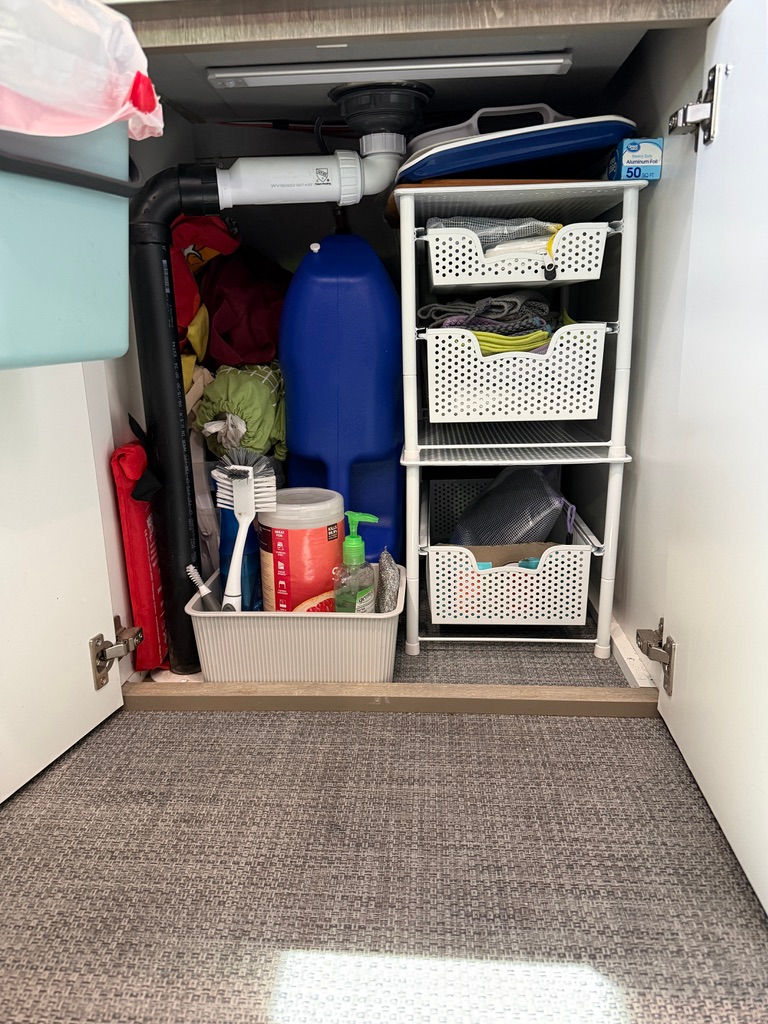
In a small camper, organization isn’t a nice-to-have. It’s the difference between a space that feels calm and a space that feels chaotic. A little intentionality here goes a long way.
Before you head to Amazon, check your local Daiso if you have one nearby. It is an absolute goldmine for small space organization: bins, containers, drawer dividers, hooks, pouches, and more, most of it perfectly sized for tight camper spaces and priced so reasonably you can try things without commitment.
Command hooks and suction cup hooks. Both work beautifully in Curiosity. The walls are smooth fiberglass, which means suction cups actually hold. A rare win. Use them for keys, leashes, jackets, towels, anything you reach for constantly.
Bins and fabric baskets. Target’s fabric baskets are a great find: soft-sided, easy to squeeze into tight or oddly shaped spaces, and they look good doing it. Use them to corral categories: dog stuff, toiletries, snacks, whatever tends to wander.
Drawer organizers for the kitchen. Curiosity’s kitchen drawers are shallow and things slide around. A simple drawer organizer keeps your utensils and tools from becoming a scrambled mess every time you hit a bumpy road.
Shelf liner throughout. Tuck it under everything that might shift while you’re driving. Cheap, lightweight, and one of those things you won’t know you needed until the first time something slides off a shelf mid-corner.
Collapsible totes for under-bed storage. The space under the bed in Curiosity is genuinely useful, but only if you can get to it. Collapsible totes let you pack that space efficiently and pull things out without excavating the entire storage area. When you don’t need them, they fold flat.
Dogs (If You’re Traveling With Them)

Traveling with dogs isn’t a nice-to-have situation. Their needs are just as non-negotiable as yours. Get their setup right from the start and everyone sleeps better.
Treats are currency on the road. Pack more than you think you need.
Their bed or a familiar blanket. Familiar smells help dogs settle in a new space. Don’t underestimate it.
Food, pre-portioned and ready. Measure out their meals before you leave. One less thing to figure out at the end of a long driving day.
Treats. More than you think you need. Treats are currency on the road: for settling in, for new environments, for the moments when everything feels a little unfamiliar and you need to remind them (and yourself) that this is going to be great.
A spill-proof water bowl. A tipped bowl in a small camper is a bigger deal than it sounds. Get one that stays put.
Leashes. More than one if you have multiple dogs. And know where they are before you need them.
Poop bags. Always more than you think. Always.
The things you order on Day Three are often the things you’ll never camp without again.
The Extras That Earn Their Space
Some things don’t fit neatly into a category but absolutely earn their spot in Curiosity. These are the small additions that quietly make life on the road better every single day.
Dehumidifier bags. Moisture builds up in a small camper faster than you’d expect, especially overnight or in wetter climates. Dehumidifier bags are inexpensive, take up almost no space, and protect your camper, your gear, and your bedding from that creeping dampness. Tuck them in closets, under the bed, and in storage areas.
Microfiber quick-dry towels. Rain, dogs, post-hike showers. These do triple duty and dry fast in a small space. Worth every penny.
A zippered cord and cable pouch plus velcro ties. Cord chaos in a small camper is a very real thing. A single zippered pouch keeps all your cables in one place. Velcro ties keep each cord bundled and tangle-free. It sounds like a small thing until you’re digging through a drawer at 6 a.m. looking for your phone charger.
Zip ties. Bring them. You will use them. You will not be able to explain in advance exactly how, but you will use them.
Felt furniture strips. Day Three order. Stick them on the back of your blinds where they knock against the window frame and you will sleep so much better. Such a small thing. Such a big difference at 2 a.m.
A Muddy Mat for the entryway. Day Three order, and worth every single penny. Traveling with dogs means dirt, mud, wet paws, and general chaos at the door. A good Muddy Mat catches most of it before it reaches your floor. If you have dogs, this is non-negotiable.
The Things That Just Make It Home

Not everything in Curiosity earns its space by being useful. Some things earn their space by being right. I didn’t know that the first time I packed. I do now.
A disco ball. It does nothing. It is perfect.
A little pot of succulents in a bird-shaped pot. Something living. Something that needs tending. It turns out that matters on the road.
Taylor Swift heart hands. Non-negotiable. Always.
A paint by numbers kit. Not for now. For a slow afternoon later this summer when there’s nowhere to be and nothing that needs doing. I’m already looking forward to it.
What I Wish I’d Left Behind
This is the part no packing list ever tells you.
My most dedicated travel companions for those 1,800 miles to Buffalo weren’t anything I packed. They were the fears that rode shotgun the entire way. Flat tires. Sideswiping a car. And the big one: not being able to back up. That last one, for the record, still haunts me.
My only towing experience before this trip was at eighteen years old. The hitch had broken on our family camper at a horse show, three hours from home. Someone handed me the keys to a stick shift Jimmy and I learned to tow between classes, with my horse in the trailer, terrified the entire time. It was the most terrifying day of my life. I got us home. But “I once towed a horse trailer in a crisis as a teenager” was not exactly the confidence-building foundation I was working from heading into this trip.
Here’s what I’ve learned: most of those fears don’t go away before the trip. They go away on the trip, mile by mile, as you realize you’re more capable than the voice in your head is giving you credit for. You figure it out. You always do.
The fears don’t go away before the trip. They go away on the trip.
What else do I wish I had left behind?
The “just in case” items that lived in a bag untouched. I brought a full set of tools I didn’t know how to use. They took up half a cabinet. Leave the aspirational gear until you know what you actually need.
Too many clothing options. I wore the same three outfits in rotation. Pack what you’d bring for a week. Then remove two things.
The pressure to have it perfect. This one wasn’t in a bag, but I brought it anyway. It is heavy, it takes up space, and it doesn’t improve anything.
One Last Thing Before You Go
No packing list, including this one, is the final word. It’s a starting point.
Some of the best advice I’ve picked up has come from other campers and travelers. People who’ve already made the mistakes, already figured out what works, and are generous enough to share it. Seek those people out. The camper community is remarkably willing to help, and there’s no reason to learn everything the hard way when someone else has already done so.
And keep coming back to this question as you go: how am I planning to camp? Because what’s sufficient for a weekend can absolutely drive you nuts after weeks on end. I’ve redesigned the space under Curiosity’s kitchen sink three times trying to improve the functionality. I added a Roku soundbar for the factory-installed TV, and yes, I know, tv isn't camping. But there’s a real difference between a weekend in the woods and living somewhere for a month. What seems unnecessary often isn’t. That’s not failure. That’s refinement. The bottom line is: You won’t know what you actually need until you’re living it.
Your rig will evolve. Your systems will improve. Your list will get better every trip.
The goal isn’t a perfect setup. It’s a setup that gets better because you’re actually out there using it.
Start. Adjust.
Want more of this? The Sol Season Letter goes out the last Monday of each month: one grounded letter with what’s working, what I’m learning, and what’s next on the road. No inbox clutter. Just honest, intentional content from someone actually living it.
Keep Moving.
Rachel


Comments